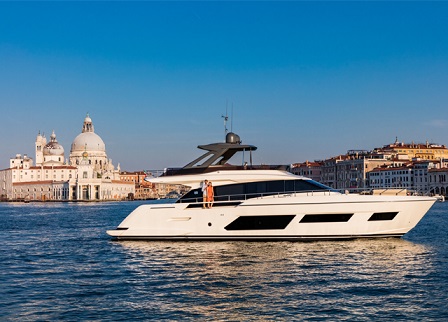

Ferretti Yachts 670 is the shipyard’s first gift to itself – and the rest of the nautical world – as the brand celebrates its 50th Anniversary in 2018.
Officially presented on June 22nd in Venice, this fabulous flybridge elevates even further the standards of style, comfort and performance that have always defined Ferretti Yachts’ DNA.
Born from the partnership between Ferretti Group’s Engineering Department and its Product Strategy Committee, this is the first Ferretti Yachts creation to boast an exterior designed in collaboration with architect Filippo Salvetti. The interiors, instead, were crafted by the Group’s own architects and designers. As part of an innovative evolution process, Ferretti Yachts 670 combines certain characteristics of the models launched in 2016 and 2017 (Ferretti Yachts 450, 780, 850 and 920) with some significant new features. These include an outstanding optimization of interior and exterior spaces, offering owners and their guests a perfect blend of communality and independence. The Ferretti Yachts 670 measures 67 feet (20.24 metres) but incorporates a number of solutions typically seen on larger vessels. This design approach is plainly evident from the yacht’s layout, available in a standard 3-cabin configuration on the lower deck as well as a version with 4 cabins. The design is essential, rigorous, characterized by clear and stretched lines that provide the yacht with an elegant and sportive look, typical features of all the recent Ferretti Yachts creations.
EXTERIORS
On the stern, there is a large swimming platform with an H+B vertical tender lift capable of accommodating a 3.45 m jet tender. Among the distinctive features in this area are two storage compartments: one in the upper part and one in the lower part of the stern sofa. A Seabob can be kept in the latter.
The outside fore area, instead, presents a fascinating innovation in terms of space optimization, with an ample living area, that can be entirely covered by a bimini top and is formed by three spacious sofas that face one another. On request, along the side sofas it is possible to install two dining tables facing each other, which can in turn be converted into relaxation surfaces so as to transform the whole area into one big sun pad.
The ample flybridge, which at 24 m² is one of the most spacious in its class, can be fitted with free-standing furniture aft, while in the central area, to the left, is a fully equipped bar that faces an entertainment area with a C-shaped sofa and a dining table. Moving forward, you come to a second control station on the left and then a very large sea-facing sun pad. Ferretti Yachts offers 3 different layouts for this flybridge: the standard open version, a version featuring a roll bar for satellite systems with built-in Bimini top, and finally a hard-top version.
INTERIOR SPACES and TECHNOLOGICAL INNOVATION
A glass door in the cockpit opens up onto the main deck lounge, with its two beautiful facing sofas, upholstered in Zimmer + Rohde fabric, and centralized coffee tables. Further along, the dining area features an attractive open-plan kitchen and dining table. Beyond the kitchen is the helm station: a cutting-edge technical space equipped with integrated Naviop-Simrad instrumentation, inspired by the innovative solution already adopted on larger models such as Ferretti Yachts 780, 850 and 920. For the first time in this length-class, in fact, the integration of a single innovative multi-display interface makes it possible to monitor all the main functions, not just from the main helm station but also from the fly bridge.
The state-of-the-art electro-hydraulic steering system, developed in collaboration with XENTA, replicates the one already seen on the Ferretti Yachts 780 model. Among its many benefits is greater steering comfort thanks to the extremely easy handling of the helm and maximum efficiency when turning, in any sea conditions and even at high speeds. The steering system can be integrated with a cutting-edge joystick package, paired with a powerful proportional thruster, which includes the DOCKING and TILLER/CRUISE functions, for an engaging and dynamic sailing experience. An innovative Dynamic Positioning System (DPS) for shaft-line propulsion is also present.
Moving along, to starboard there is a door that provides direct access to the bridge from an outside walkway. Hidden under the steps to the lower deck is a space that can be used as an additional stowage compartment.
Below deck, owners can choose either a 3 or 4-cabin layout, which in itself is a testament to the superior use of space achieved with this model. The former offers 3 cabins with the owner’s suite, located amidships, which even includes a spacious study that can double as a private space for the owner, for a total surface of 18 m². The bed is in the centre of the room, and behind it, towards the stern, are a walk-in closet on the port side and a large bathroom to starboard. This layout offers better soundproofing against the noise from the engine room, which is another significant benefit of the design.
There is the option of replacing the study next to the owner’s cabin with a fourth cabin or a laundry room. On the starboard side there is a double cabin, while the foredeck is home to the VIP cabin. Both have a bathroom and separate shower. On the lower deck there is also a crew cabin with bathroom. It is at the far end of the stern and has easy access to the cockpit via a built-in ladder.
For the interiors, the shipyard offers a version inspired by lighter tones and colours as well as a darker version. The style of the first unit is characterized by linear modules and wood strips, with contrasting light and dark hues. Precious woods abound, with opaque surfaces for ceilings and floors and glossy ones for the furniture. Below decks you will find walnut essences on the bulkheads, striped wood furnishings both glossy and opaque, lacquered surfaces and nubuck upholsteries. Beds, drawers and bookshelves present a refined leather effect.
A number of metallic elements in the lounge and bronze-glass details in the owner’s suite provide a stunning visual impact. Headrooms stand out for the generous use of Calacatta Gold by Florim. Designer luxury brands featured on board also include Lealpell, Dedon, Disenia, Casamance and Perennials.
Ferretti Yachts 670 will also be available in the exclusive Tai He Ban version, conceived specifically for the Asia Pacific market, which includes a galley below decks and the addition of a rounded table on the main deck.
ENGINES
The Ferretti Yachts 670 is fitted with twin MAN engines rated at 1200 mHP, giving it a top speed of 32 knots and a cruising speed of 28 knots (preliminary data). Alternatively, MAN 1000 mhp engines are also available. Available on request, a stabilization package with two gyroscopic Seakeeper stabilizers guarantees the utmost stability while cruising or when docked.
Ferretti Yachts 670 è il primo regalo che il cantiere ha fatto a sé stesso e al mondo della nautica per celebrare il 2018, anno del 50° Anniversario. Presentato ufficialmente lo scorso 22 giugno a Venezia, questo fantastico flybridge alza ulteriormente gli standard di eleganza, comfort e prestazioni da sempre nel DNA del marchio.
Frutto della collaborazione fra Comitato Strategico di Prodotto e Direzione Engineering Ferretti Group, è il primo Ferretti Yachts il cui design esterno è stato realizzato da Ferretti Group in collaborazione con l’architetto Filippo Salvetti, mentre gli interni sono opera degli architetti e dei designers del Gruppo. Nel segno di un’evoluzione intelligente, Ferretti Yachts 670 propone a bordo alcune delle caratteristiche presenti nei modelli lanciati fra 2016 e 2017 (Ferretti Yachts 450, 780, 850 e 920), alle quali si aggiungono importanti novità. Fra queste si apprezza un’eccellente ottimizzazione degli spazi, interni ed esterni, che assicura all’armatore e ai suoi ospiti il perfetto mix di convivenza e indipendenza. Ferretti Yachts 670 è infatti un 67 piedi (20,24 metri) che installa soluzioni tipiche di un’imbarcazione di maggior piedaggio. Questa filosofia è evidente già osservando il layout: disponibile nella versione standard a 3 cabine sul ponte inferiore o a 4 cabine. Il design si presenta essenziale, rigoroso, caratterizzato da linee tese e pulite che conferiscono allo yacht eleganza e sportività, elementi ormai tipici di tutte le ultime imbarcazioni della nuova gamma Ferretti Yachts.
AMBIENTI ESTERNI
A poppa ritroviamo una grande spiaggetta tender lift H+B a traslazione verticale, che può alloggiare un jet tender da 3,45 mt. Spicca la presenza, in quest’area, di due vani storage posizionati uno sulla parte alta e l’altro sulla parte bassa del divano di poppa. Quest’ultimo vano può eventualmente alloggiare un Seabob.
La zona esterna di prua, invece, propone una vera e propria innovazione a livello di ottimizzazione degli spazi: una grande zona living, che può essere coperta in maniera integrale da un bimini, è formata da tre ampi sofà contrapposti. Su richiesta, è possibile posizionare due tavoli da pranzo contrapposti lungo i divani laterali, convertibili in superficie relax, così da poter trasformare tutta l’area in un unico prendisole.
L’ampio flybridge, che con circa 24m² di superficie è tra i più competitivi della categoria, può essere arredato freestanding a poppa, mentre al centro, sulla sinistra, c’è un mobile bar fully equipped, fronteggiato da una zona conviviale con divano a C e tavolo da pranzo. A prua, la seconda stazione di comando sulla sinistra precede un grandissimo prendisole fronte mare. Ferretti Yachts propone per questo flybridge 3 diversi layout: aperto nella versione standard, oppure, in via opzionale, con un roll bar per gli impianti satellitari con bimini integrato, o in versione hard top.
AMBIENTI INTERNI e INNOVAZIONE TECNOLOGICA
Sul pozzetto, oltre la porta vetrata, si accede al salone del ponte principale formato da due ampi sofà contrapposti, rivestiti in tessuto Zimmer + Rohde, con tavolini centrali. Più avanti, ecco la zona pranzo con cucina aperta e, di fronte, il tavolo da pranzo. Oltre la cucina, la plancia di comando: uno spazio tecnico d’avanguardia dotato di strumentazione integrata Naviop-Simrad, ispirato all’innovativa soluzione installata su modelli più grandi quali Ferretti Yachts 780, 850 e 920. Per la prima volta infatti in questa fascia di piedaggio, attraverso l’integrazione in un’unica innovativa interfaccia multi display, è disponibile il monitoraggio delle principali funzioni, non solo in plancia principale ma anche dalla controplancia del fly.
Degna di nota la timoneria elettroidraulica di nuova generazione sviluppata in collaborazione con XENTA, già lanciata su Ferretti Yachts 780, che tra i tanti vantaggi offre una maggiore comodità e precisione di guida grazie all’estrema maneggevolezza del timone e una messa a punto ottimale della virata in ogni condizione di mare, anche a velocità sostenute. Il sistema di timoneria può essere completato con un pacchetto joystick di ultima generazione, accoppiato ad una potente elica di manovra proporzionale, che include le funzionalità DOCKING e TILLER/CRUISE per un’esperienza di navigazione dinamica e divertente. Ulteriore funzionalità, il DPS (Dynamic Positioning System), innovativo per propulsioni shaft line. Proseguendo, a dritta vi è una porta di accesso che consente la comunicazione diretta tra plancia e camminamento esterno. Gli scalini che conducono al ponte inferiore nascondono uno spazio sottostante sfruttabile come ulteriore vano stivaggio.
Una volta sottocoperta, l’armatore può scegliere tra il layout a 3 o 4 cabine, a conferma del raggiungimento dell’obiettivo di ottimizzazione degli spazi. La prima unità prevede 3 cabine con la suite armatoriale situata a centro barca, che comprende un grande studio che funge da ambiente privato per l’armatore, per un totale di 18m² di ampiezza. Lo spazio è organizzato con letto centrale e, alle sue spalle verso poppa, una cabina armadio dedicata sulla sinistra e il grande bagno a dritta. Questo allestimento garantisce maggiore isolamento acustico dalla sala macchine, altro notevole plus di questo progetto.
In via opzionale, lo studio che introduce alla cabina armatoriale può essere sostituito con una quarta cabina oppure con una lavanderia. A dritta c’è una cabina doppia, mentre a estrema prua ritroviamo la cabina VIP, entrambe con bagno e doccia separata. Sul ponte inferiore è situata anche la cabina marinaio con bagno, localizzata a estrema poppa con accesso dal pozzetto, facilitato da una scala integrata nella struttura.
Per gli interni, il cantiere offre all’armatore la possibilità di scegliere tra una versione ispirata ai colori e alle tonalità chiare e una versione più scura. Lo stile della prima unità è caratterizzato da listelli e moduli lineari, con differenze cromatiche tra chiari e scuri. Come materiali, si alternano essenze pregiate opache nei cielini e sul pavimento, e lucide nei mobili. Sottocoperta, essenze noce nelle paratie, mobili in legno rigato lucido e opaco, superfici laccate e rivestimenti in nabuk. Letti, cassetti e librerie presentano un raffinato effetto cuoio.
Di grande impatto estetico la presenza di alcuni elementi in metallo nel salone e di altri in vetro bronzo nella cabina armatoriale. I bagni sono caratterizzati da un vasto uso di Florim Calacatta Oro. Da sottolineare la presenza di prestigiosi marchi del design di lusso, tra i quali Lealpell, Dedon, Disenia, Casamance e Perennials.
Ferretti Yachts 670 sarà disponibile anche nella versione speciale Tai He Ban, dedicata agli armatori dei mercati Asia Pacific, che prevede l’allestimento della cucina di servizio sottocoperta e l’introduzione di una sala da pranzo con tavolo rotondo sul ponte principale.
MOTORIZZAZIONE
Ferretti Yachts 670 è equipaggiato con una coppia di propulsori MAN dalla potenza di 1200 mhp, raggiunge i 32 nodi alla massima velocità e i 28 nodi ad andatura di crociera (dati preliminari). Sono altresì disponibili i MAN 1000 mhp. Su richiesta è disponibile il pacchetto stabilizzazione composto di due giroscopici Seakeeper per garantire la massima stabilità durante la sosta in rada e in navigazione.