
ITALY PAVILION AT EXPO 2015
CONCEPT
Italy nursery
The underlying concept for the Italy Pavilion is for it to be a “nursery” or “seedbed” for Italy. The idea is that it is a protected space in which projects and talented people can germinate in fertile ground. It is a place where young energy from across the country can be foregrounded and welcomed.
The nursery metaphor has multiple interpretations that highlight and encourage various aspects of Italian culture and society during this period of change. It is a seedbed of ideas, proposals and solutions for the entire country. And these solutions will be offered to the global community. It is a space for growth, development and training. A workshop. A laboratory. In essence, it is a place in which the talented young people of our country can be showcased, helping also to shine the limelight on universities and research centres.
Pride for Italy
The Italy Pavilion’s vision statement is “Orgoglio Italia”, which can perhaps best be translated as “Pride for Italy”. Pride for Italy is an expression of the extraordinary contribution that Italy will make to this World Expo. It is a vision – a realistic vision – that takes careful stock of the challenges faced by the nation today, but looks forward positively to tomorrow.
VISITOR EXPERIENCE AT THE ITALY PAVILION: A LARGE, COLLECTIVE STORY
The Italy Pavilion is not only a space for answers, but also for questions in the Socratic tradition. Visitors are encouraged to look demandingly at what is on display, becoming active participants in an experience that is surprising, entertaining, stimulating and educational.
The Italy Pavilion is a giant nursery, a land in which the seeds of the future can sprout and grow. And Italy is offering these seeds up to the world as its contribution to the “Feeding the Planet, Energy for Life” theme.
PALAZZO ITALIA
Home of Italian identity
The Italy Pavilion provides answers and food for thought using four conceptual axes: power of know-how; power of beauty; power of the limit; and power of the future.
Visitors to Palazzo Italia are immersed in an opportunity to understand and explore the essence of “Italian identity”. A clear, consistent vision runs through the entire display area, creating a space that will become a source of pride and belonging for Italian visitors, while sparking a renewed sense of curiosity in international guests.
The entire display route can be broken down into the four key values – or “powers” – of Italy that were identified as part of a lengthy process that involved Censis, Aaster and, in two vibrant years across the country, the regions.
1. Power of know-how: creativity, excellence, innovation
2. Power of beauty: tourism, quality of life, Italian landscapes
3. Power of the limit: tradition, resource management, resilience
4. Power of the future: seeds of the future, natural seeds and entrepreneurial seeds
GROUND FLOOR
Art icon
On the ground floor, Italian contemporary art provides visitors with the first food for thought. Here, classicism and contemporary art fit perfectly with the stylistic features of the Italy Pavilion.
The artworks are a functional part of the display route that moves its way through the pavilion providing a view of the identity of the entire country.
The Italy Pavilion exhibition includes a wonderful sculpture created specifically for Milan Expo 2015 by Vanessa Beecroft, one of the best internationally known Italian artists. This work – called Jennifer Statuario – consists of two sculptures created using a real cast of the artist’s sister. The style adopted is classical-figurative, but the upside-down positioning of the piece, along with other elements, aims to destabilise the classical ideal. This work elaborates on the concept of the membre fantome or the phantom art syndrome the artist has been exploring since 1993.
Further along the route, a statue of Hora represents the very classicism that Beecroft destabilises. This work, made of Carrara marble from Luni, is probably 1st century AD, with additions to the head, base and hands in the mid-16th century. The “garments” that cloth this goddess are so realistic that, in their intangibility, they almost seem to be actual fabric. These works place women at the very centre of the Italy Pavilion, giving them a leading role once again, like in the WE-Women for Expo projects. This reiterates the centrality of women in society and the family.
Both of these pieces are filled with meanings that weave into the Expo 2015 themes, especially as the protagonists are women and the works create interaction between past and future.
FIRST FLOOR
Power of know-how
21 stories from 21 regions to explore our know-how. A sculpture installation depicting men and women practically creates a “living picture” in which ingenuity, applied creativity and innovation are essential elements. This is an ultramodern vision of professions that represent some of the most important and distinctive jobs and businesses in our land. It is a space in which visitors can discover the stories of men and women who make our land rich and productive every day.
SECOND FLOOR
Power of beauty
Reality cannot be escaped here. This section starts with a distress chamber and the TG NEWS WALL (monitor with a news feed geared to environmental emergencies), forcing visitors to face up to the reality and consider, definitely, the state of our planet. This initial shock is followed by three heavily symbolic rooms in which the true power of Italian beauty can be discovered. Here, breath-taking interiors, landscapes and architectural structures are captured using techniques that truly draw out their unique nature. A system of mirrors visually reflects the views, interiors and landscapes, while a kaleidoscopic approach simultaneously breaks them up to create truly original images that give visitors a new view of beauty in an infinitely immersing vision. The concept of beauty here is framed within the rules of perspective, where such rules are conveyed by the arrangement of landscapes (always presented as a “consistent horizon” for the observer) and the structure of the room. Perspective itself is a metaphor for “looking beyond”, a synonym of vision and the ability to create new projects.
Yet, such beauty cannot be detached from “work”, as effort is needed to conserve and protect such beauty. Thus, the pavilion’s display seeks also to impress on visitors the importance of maintaining and restoring our enormous artistic heritage.
Contrast is another key word. Visitors will be able to revisit the dramatic moment when St Francis’s basilica collapsed, watching a film and then, looking down, seeing debris and rubble on the ground. The contrast comes from looking to the side, where the frescoed façade of the building is once again whole, the outcome of an extraordinary restoration effort.
The “Italy: What if we didn’t exist?” installation provides another moment of reflection, presenting a giant model of the Mediterranean, but without Italy. The question is evident: what would the world be like today if Italy wasn’t there. Video clips of interviews with people of international standing give visitors their thoughts. Visual illusions in a 3D installation at the centre of this display area encourage visitors to consider the role and importance of Italy in the development of knowledge and culture in Mediterranean countries and, probably, in the entire world.
The final part of the visit on this floor is another surprise: an installation exploring beauty through other senses.
This sensorial route in the dark allows visitors to explore a market by listening, smelling and touching. The initial effect is of disorientation, but this is followed by the hyper-activation of the senses, allowing one to detect and interpret the various smells, shapes and textures. At the end, visitors rediscover their sense of sight and gaze on Renato Guttuso’s “La Vucciria”, a perfect summary of what was perceived without sight. It is a wonderful final touch, a chance to enjoy the majesty of this work. As such, art has become the epilogue to this journey through beauty, sealing the humans-food-land pact.
THIRD FLOOR
Power of the limit and power of the future
In this section, the creativity and ingenuity of regions and local areas come to the fore, seeing the future as exceeding limits.
It is a tale of people, both normal and extraordinary, who draw on their own ingenuity to win battles facing great and small adversity, turning obstacles into ideas that will change our future. Holograms, objects and film clips are the tools used to tell these stories.
The space is dominated by a replica of The Tree of Life in the centre, its branches reaching out literally to the protagonists in this section. Such symbolism is at the very heart of the entire exhibition route through the pavilion and provides the final piece in Italy’s response to the questions posed by Expo 2015.
Italian biodiversity
21 plants from regions and areas across Italy: the Italy nursery
“Future seeding”: Italian biodiversity. 21 plants – one for each region – tell the story of the extraordinary biodiversity of the Italian landscape. The installation here drew inspiration from the work of a great Italian educator to provide a moment of recreation in which the visitor can take away a tangible sign of a visit to Palazzo Italia.
This floor includes a classroom, which will host educational workshops for schools, and the Bruno Munari space for Expo 2015, an artistic and interactive installation to learn, in a funny way, how to recognize the different plants of Italy and to place them in their origin regions.
Italy’s response to the “Feeding the Planet, Energy for Life” theme of Expo 2015 is the Milan Charter.
CARDO
Exhibition areas: “A storytelling journey”.
The Cardo is a road that runs right across the Italy Pavilion. The content presented along this axis is related to three concepts: Production, Evolution and Nature. It is a visual and sensorial feast. The regions of Italy will present material that cuts across and is consistent with all the themes explored in the Italy Pavilion and Expo 2015, focusing predominantly on the humans-food-land pact. The Cardo also provides visitors with the chance to discover, through installations, stories and tasting, the excellence of Italian food production.
The guide for this entertaining section is actually an app that will show people where to go, and provide additional information and food for thought depending on the “programme” for the day.
THE TREE OF LIFE
Italian symbol, global icon
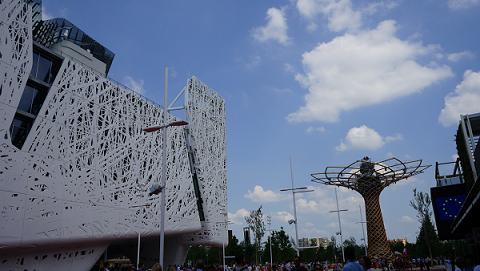
The Tree of Life is the physical symbol of the conceptual route through the pavilion. The roots lie in the excellence of Italy (Palazzo Italia, the exhibition spaces), but it then draws these up (Cardo) and offers them in a vast, symbolic gesture that clearly recalls the dissemination of seeds (The Tree of Life).
The Tree’s roots lie in the power of Italian excellence and they draw this up and, in a sculpted and highly symbolic gesture, project it towards the sky, to redistribute it to the benefit of the entire planet. The Tree is also a recipient for Italy’s extraordinary variety, power and ability to produce beauty. The origins of our Tree are deeply rooted in our cultural heritage. It was when looking at the mosaics of the Cathedral of Otranto that this image, for the first time, thrilled Marco Balich. The echo and the influence of this symbol can be found in Michelangelo’s remodelling of Piazza del Campidoglio and in the East. Indeed, it is found in numerous cultures across the world as a key historical and spiritual element, but the cinema has also turned it into an incredibly contemporary symbol of the collective imagination.
Its creation was possible thanks to the sponsorship of Coldiretti and Pirelli, the building expertise of Orgoglio Brescia (a consortium of 19 companies from the Brescia area) and the Studio Giò Forma architecture practice.
Rising 37m with a circumference of 45m, the structure is designed to provide a public show every hour throughout the Expo, with fountains, music, lights, colours, projections and fireworks.
ITALY PAVILION MILAN EXPO 2015
Architectural design by Nemesi & Partners
DESIGN OF THE ITALY PAVILION
The design chosen for the Italy Pavilion was the winning project in an international competition adjudicated by Expo 2015 S.p.A. in April 2013. In total, 68 architectural practices took part, but the winning design came from Nemesi & Partners in association with Proger and BMS Progetti (for the structural engineering and installations) and Prof. Livio De Santoli (for building sustainability). The pavilion is located on the Cardo, which is one of the two perpendicular axes of the Milan Expo 2015 site, along with the Decumanus.
The Italy Pavilion consists of the creation of Palazzo Italia (c. 13,200m2 with 6 aboveground storeys) and some temporary buildings along the Cardo (c. 13,700m2 with 3 aboveground storeys).
Experimentation lies at the very heart of the design. The hallmarks of Nemesi’s project are the use of innovative technology and a sustainable approach. These elements merge with the expertise and skills of the Italian companies involved in building the pavilion to make it a symbolic hub of contemporary creativity.
ARCHITECTURE OF THE ITALY PAVILION
Palazzo Italia is a genuine landmark on the Expo site, standing out because of its architecture and its location on one of the four cardinal points – the northern one. It also provides a scenic backdrop for Viale del Cardo, which runs right across the site.
Palazzo Italia draws on the concept of an “urban forest”, with the “branched” outer envelope designed by Nemesi to simultaneously conjure up primitive and technological images. The weave of lines creates a play of light, shadow, solids and voids that generates a sculpture-like building with clear hints of land art.
For Nemesi, the spark for Palazzo Italia was a concept of cohesion in which the force of attraction generates a rediscovered sense of community and belonging. The internal piazza represents the community’s energy. This space – the symbolic heart of the complex – is the starting point for the exhibition route, in the midst of the four volumes that make up Palazzo Italia. These four constructions could be part of a cityscape, but in reality, they house the Exhibition zone (West), the Auditorium and Events zone (South), the Office zone (North) and the Conference and Meeting zone (East). The volumes are symbols of giant trees, with massive bases that simulate great roots plunging into the earth. Seen from the internal piazza, they open up and become longer as you look up, visually forming a canopy beyond the giant glazed roof. The rich weave of branches that forms the outer envelope helps to highlight the sculpted shapes of Palazzo Italia. Nemesi used a unique geometric design to create this outer “skin”, recalling an unplanned weave of branches and creating architecture within architecture.
FUNCTIONAL LAYOUT OF PALAZZO ITALIA
Nemesi designed the exhibition layout of Palazzo Italia to be a gradual journey to discover and understand the shapes and content of this special architectural landscape.
The route starts from the internal piazza, a great hall in which visitors are welcomed and the curved, inclined elevations give the volumes a sense of fluidity and dynamism, forming a space of genuine beauty. The great flight of steps that rises up from the square crosses this area longitudinally to visually connect all the floors. The triple-height space from the second to the fourth storey is like a giant “hanging” shell that, visible from the piazza, houses the Exhibition zone.
Palazzo Italia has spaces to host events on the ground floor and, on the upper floors, exhibition areas, meeting and conference rooms, and elegant open and eating areas, including a top class restaurant on the fourth floor and a panoramic terrace.
The building will also have space for various institutions, including the Italian Government, and areas to showcase Made in Italy excellence.
INNOVATIVE AND SUSTAINABLE APPROACH
In designing Palazzo Italia, importance was placed on sustainability and on making it practically a zero energy building through the use, among other aspects, of photovoltaic glass for the roof and photocatalytic concrete in the outer envelope. The full 9,000m2 of the external façade of Palazzo Italia will be clad in 900 i.active BIODYNAMIC concrete panels with Italcementi’s patented TX Active technology. When this material comes into contact with light, it can “capture” pollution in the air, transforming it into inert salts and reducing smog levels. The mortar used is 80% recycled aggregates, including scrap material from marble quarries in Carrara that helps add more lustre than in traditional white cement. This new material is also very “dynamic”, enabling the creation of fluid designs like the complex shapes used for the panels that are part of the construction of Palazzo Italia.
Each panel for the external envelope is unique and will be created using Styl-Comp technology.
The roof designed by Nemesi for Palazzo Italia will be an innovative “sail” created by Stahlbau Pichler. It will be an interpretation of a forest canopy, with photovoltaic glass and flat and curved geometric shapes (often squares). Together with the building’s envelope of “branches”, it will be a manifest expression of innovation in design and technology. The roof reaches its architectural height above the inner piazza, where a massive glazed conical skylight “hangs” over the square and the central steps, radiating natural light.
BUILDINGS ALONG THE CARDO
The Italy Pavilion includes a series of temporary buildings that will look out onto the Cardo, a paved road spanning 35m and running for 325m from Piazza d’Acqua in the north to the square on Via d’Acqua in the south. These are being built using “dry” technology to facility their removal and relocation when the Expo ends.
Nemesi used the idea of an Italian village to develop the buildings along the Cardo, creating volumes juxtaposed with small squares, terraces and covered walkways. Different geometric shapes, at times overhanging, are assembled to almost form a giant mosaic in which each piece has its own design and autonomy. The ground and first floors are often little squares produced by the alternation of architectonic volumes.
The buildings along the Cardo will represent the different parts of Italy, especially the regions, providing them with meeting and exhibition areas. The area facing Palazzo Italia, along the northern part of the Cardo, will be used for the institutions, exhibitions and meetings that fall under the European Union Pavilion, providing a symbol of the close ties between Europe and Italy.
The buildings along the Cardo include the European Union Pavilion, exhibition areas, spaces for events and meetings, eating areas and terraces.
PALAZZO ITALIA, the exhibit – The strength of limit
Ferrari farm – Lazio
My name is Giorgia, and I’m stubborn by trade: I built my hydroponic farm in Italy with only 100 hectares at my disposal.
I guess you could say my training in aerospace engineering made me do it: I figured that if we ever make it to Mars, we won’t be able to cultivate the land, because the soil itself will be different. I researched the issue and found out that the Hanging Gardens of Babylon used hydroponics, which made me think of a couplet: an ages-old technique for the future of mankind. The future of agriculture …because agriculture is a science .
Perfect agriculture is hindered by the soil and air, which are not sterile, and which may be polluted by human activities. And so I told myself: we can’t physically remove air, but we can sterilize it. On the other hand, we can remove the soil completely and replace it with controlled nutrients.
And I did it………I did it to prove that crops can be grown anywhere in the world, regardless of pollution or climate, from the North Pole to the Equator. I could grow tomatoes in the Sahara desert!
Dalila Trupiano – Molise
We study the DNA of the vegetables grown by Molise’s farmers.
Take beans, for example. There are many different varieties in our region, and our farmers preserved them while natural selection was adapting them to the local environment.
They may be justified in being jealous, but fear of science is a big obstacle for them and for us.
My name is Dalila, and in this lab we carry out genetic studies to characterize the many varieties of vegetables that are brought to us.
It is the only way to certify the product and improve its marketing. It’s easy to say, as our farmers do, “this one is better. But how do you prove it?
Perhaps a certain flavour is characterized by a specific molecule, or the vegetable contains substances that are good for our health. The Capracotta lentil, for instance, contains great quantities of a powerful anti-cancer protein named after Bauman and Birkman. This is a big plus, but without scientific analysis, how could one make that claim?
We work with seeds, and in a way we produce seeds of knowledge that enrich the global nutrition map.
Pier Paolo Visone – Abruzzo
My name is Pier Paolo and I got it into my head to do something for the saffron – the scent of my childhood – produced in my native L’Aquila.
Although saffron wasn’t originally well-suited to cold climates, this problem was overcome as early as the Middle Ages by selecting the bulbs best adapted to the local environment. It became a luxury good, the most prized in the world according to the literature of that era.
Around here, people say dreams end at dawn, but I did not want it to be like that.
I studied, I brought our saffron to research centres, and eventually discovered that it contains a molecule that sets it apart from all other types of saffron and can help treat certain eye disorders, such as macular degeneration.
From lab experiments to success: in addition to the traditional cooking market, our product is present in the pharmaceutical market as well, boosting its value.
They were right back in the Middle Ages. Now we know why.
Sergio Gamberini – Liguria
My name is Sergio, and I have always been an entrepreneur… in the underwater realm.
I always dreamed about bringing terrestrial environments underwater, like Jules Verne and Buster Keaton, but for real.
I did it…..I grow basil underwater….. I did it!
There are some obvious problems: underwater pressure is much greater than atmospheric pressure, and conditions are different, as are the life forms.
Imagine the look on people’s faces when I told them about my idea! But I did it, through technologies I control I created a terrestrial biosphere underwater. It’s not just an experiment, though, and I’m not insane.
Think how useful it would be to build something like this along desert coasts, where cultivation on land is impossible due to the extreme changes in temperature between day and night.
But underwater temperature remains essentially the same, and we can control pressure in accordance with the laws of physics.
We could produce freshwater and feed a great many people who are currently struggling in desert climates and environments.
Mauro Jaccod – Valle D’Aosta
Making classic spumante among the glaciers of the Mont Blanc was and continues to be a thrilling adventure.
Elevation is not the problem here, but mindsets can be. We have always overcome high altitude, but defeating clichés is our toughest climb.
My name is Mauro, and my adventure began ten years ago with Courmayeur’s Alpine guides. It continues today with the Mont Blanc cableway.
It began out of curiosity but now, among the snow and the glaciers, we have managed to bring out the character and elegance of our sparkling wine by putting together people from outside the world of wine, but who truly embody our extreme landscapes.
Sure, it’s difficult, a little like when we push ourselves past our limits to reach the summit: new doors are opened, and the adventure continues.
Orange Fiber – Sicilia
I am Enrica, and I used to share a flat in Milan with my friend Adriana when we were students. Now we’re partners.
We share the same dream, creating textiles from the by-products of the processing of our Sicilian oranges.
The industry juices them, and we try to squeeze out what’s left in what they throw away.
Our graduation, our research, the patent: we never imagined we would have created our own network drawing together know-how from Sicily to Milan and from Spain to Como.
There are no pilot factories to test our production, nothing between our lab and the industry: this is the obstacle. We have overcome it thanks to those who believed in us and who gave us the infrastructure, capital, and inspiration.
With heart and passion, we created the first-ever textile from orange juice by-products. Why? Because we are Sicilian women, and we have strength and passion to spare.
Lelio Mondella – Lombardia
My name is Lelio Mondella, and I represent Italy’s leading sturgeon-farming enterprise.
It was a pipe dream when we began, and what’s more, sturgeons were endangered, and its fishing would soon be banned.
At the time, farming sturgeon for its flesh and to produce top-notch caviar was a gamble, and we aimed for the same quality as in its traditional Caspian home.
The local habitat and the water from our springs are just right, and the nearby steel plant was a problem we turned into an opportunity: they produce surplus heat, and we need it to warm up our water.
Today we export worldwide
Not many people know that three species of sturgeon used to be found in Italy, and they were mentioned in literature and art since the Renaissance times. We farm all three, and in the near future we may attempt to re-introduce them to their native habitats, so that these magnificent animals may once again live among us.
Carmelo Basile – Calabria
Have you ever heard of the ndrangheta? Are four violent attacks a problem?
Where there’s a problem, there’s an opportunity: one can either seize it, or choose to cry about it.
I am Carmelo Basile and I will tell you about a farm with quality products exported worldwide.
Our problem was waste. Thanks to a biogas plant, we now convert that waste into energy, and use the rest as fertilizer for our soil.
Efficiency benefits us all, it produces wealth.
The ndrangheta is another big problem here.
Fear turned us inward, but in order to win, we decided to look outward and adopt efficient rules. An example: the price we pay for our shepherds’ milk depends on its quality. The richer in protein, the more it is worth. It is in their interest to keep their herds healthy.
Do not fight against the dark, turn on the light.
Barbara Codan – Friuli Venezia Giulia
If you try to read food labels and don’t understand them, isn’t it a problem? It was for me.
My name is Barbara and my idea was to help those who need clear, certified information on the ingredients in their food – whether because of allergies, or because they have chosen to be vegetarian.
Just scan the bar code on the package with our app, and we will become your translator and interpreter: translators when the label is written in a bureaucratic, technical, or foreign language; and interpreters because we filter and certify our information on the basis of the scientific approach we learned at the universities where we studied.
It helps buyers make a well-informed, safe choice.
And helps producers provide information that meets their clients’ needs and demands.
The freedom to choose is a major conquest. Our app makes it possible to do so in a well-informed, scientifically-certified manner. Democracy at is best!
Bio Soil Expert – Autonomous Province of Trento
Sometimes humans work against their own surroundings. Deforested riverbanks are one such example. We wanted to try to overcome this.
We are three biotechnologists – Andrea, Paolo, and Alberto – who recently graduated university, and we are searching for environmentally sustainable solution. We wanted to combine specific micro-organisms with certain grasses.
Working together, and only together, they can solve a thorny problem, and we did not know this until now.
We did suspect it, though. The micro-organisms greatly increase the growth of these grasses’ roots, which hold the soil together, much like the hand of a benevolent giant.
Imagine planting them on slopes and riverbanks to reduce the risk of erosion and thus flooding.
Science helps communities, and this time a plant community can help us humans care for our watercourses.
Istituto zooprofilattico – Campania
My name is Antonio Limone, and ours is a public institute that certifies food products.
We do not rank foodstuffs and we are not concerned with gourmet items. Our business is health, and we serve food producers to guarantee the health of consumers.
The results of our analyses are made available to each and every customer through a QR code. It couldn’t be easier: take your smartphone, aim it at the supermarket shelf, and read the results onscreen.
The extraordinary aspect of our time is that we can get in touch with anyone directly, and use our work to tear down the walls of prejudice and fear, and turn them into awareness and trust in the scientific method: public, and thus independent.
A new idea of public health is taking shape, one where mistakes are corrected upstream of production, thus guaranteeing a safe final product.
Daniele Gioia – Basilicata
Think of how many coffee cups are brewed every day in a café, and how many coffee grounds are thrown away. Out of curiosity, I asked myself if they could be used as soil for cultivation.
My name is Daniele, and I manufacture a kit to grow mushrooms using coffee grounds.
For example, you could grow king trumpets – a highly prized mushroom grown and eaten in only a few Italian regions – in your own home and in just ten days.
These mushrooms are unique because they were born under your very eyes, under the eyes of children who watch them grow day by day.
Their flavour is unique. They are unique because they are yours.
I don’t believe the future is in coffee grounds, but feeding the planet means producing more, and we produce protein using waste, albeit from Italy’s most beloved drink.
Paolo Belloni- Puglia
Sometimes, the only thing holding you back is yourself.
I used to be a photographer – marketing, advertising, fashion – in a big city.
Back then, bonsais were all the rage, and I was photographing them when I found some seeds, which I planted.
A seedling sprouted in that pot, and I felt responsible for a birth.
It grew, unpredictably.
My name is Paolo, and something I had paid no attention to became my passion. The fig, the most neglected of all plants, of no economic value. I collected 350 different varieties.
I believe it is strategic for the future of nutrition.
It is the only fruiting plant that bears two different types of fruit at two different times of the year. It grows well near the sea. It doesn’t need to be sprayed with chemicals. It provides fresh fruit four months a year, and when dried, figs are a nourishing, easily transportable food. It does not require pollination. It self-corrects any pruning mistakes.
Generous and free, it lives on roadsides and is the shepherds’ companion during transhumance.
It is a food bank that lasts over time. Let’s stop neglecting it.
H2 – Bolzano
My name is Walter Huber, and my company produces hydrogen from renewable energy sources.
If the future of automobiles is electric, hydrogen has a role to play as well.
It is a fuel produced with renewable sources in the same places where it is used, and thus boosts local economies instead of those in faraway places.
It is not just a fuel, it is a strategy.
Its shortcomings are typical of technologies that are not well known by the citizenry, both in terms of use and in how it can be integrated to reduce losses in other transformation systems.
This is the dawning of a new technological era for transport, one so advanced in can already compete with well-established technologies.
Quentherel – Veneto
My name is Elisabetta and I am working on a basic research project on energy efficiency.
The solar energy we capture must be transformed into electricity in order for us to use it. This process has a shortcoming, since part of that energy is lost.
Plants have no such limits: they transform sunlight into energy with extraordinary efficiency, then use it to grow and multiply.
Let’s do what they do! Right, but how do they do it?
We are convinced that the subatomic world holds the secret to the elegance and efficiency that nature has achieved after millions of years of ‘experiments’.
We would like to copy its ‘facilities’ and reproduce them to benefit humankind.
We are working to improve knowledge, and our imaginations are driven by logic and observation, just like Galileo taught us.
Thanks to this, the human species developed spectacularly.
How nice it is to be able to contribute to this wonderful show!
Eros Gualandi – Emilia Romagna
My name is Eros Guaraldi, and our enterprise is engaged in precision agriculture. We are 21st century farmers.
We listen to our crops thanks to sensors that follow their growth, so that we can intervene when necessary and with the smallest possible doses, just like in modern medicine.
I remember that when my grandfather was ill, he turned to a doctor who was little more than a quack, while today we use procedures and images that allow specialists to make reliable diagnoses.
We are applying this to agriculture, in spite of the prejudices of those who think my grandfather’s ‘doctor’ was more genuine that a trained physician.
To feed the planet, we must ensure fertility and continuity, and we need the most modern technologies to do this.
We may be pioneers, but in a very near future, it is our type of agriculture that will feed the world.
Aviator – Toscana
“The master’s eye fattens the horse”, our local farmers used to say, and indeed nothing escaped their eye. But today, sharp eyes alone are not enough.
In the era of technology, with ever-larger farm fields and fewer people to watch over them, the eyes become electronic.
My name is Nicola, and together with Carmelo and other researchers we are pioneering the use of drones to oversee the growth of plants in farm fields and identify the onset of parasite-borne diseases.
Our sensors, which are installed on a fleet of drones, will make it possible to analyze and quickly identify any problems, providing farmers with the information they need to run their business as best as possible.
Bio EcoPest – Sardinia
My name is Luca Ruiu, and my job is defending crops from parasites and diseases, in order to help feed a rapidly growing global population.
My starting point was the basic principle that even insect pests get sick and die, and are no longer able to do harm. They are our enemies, but in turn they have enemies of their own. Let’s turn their enemies into our allies.
In the lab, we isolate and study microbes that are completely harmless for humans, yet are able to strike these insect pests.
I travelled around the world, and I am now back in Sardinia, where I am part of an international network that studies how science can help agriculture without harming the environment.
Loccioni – Marche
Some people say that public-private collaborations have major shortcomings. Say what?
My name is Enrico Loccioni, and I can bear witness to how a business became a local territory, and how a local territory became a business.
We decided to manage a part of the Ensino river at high risk of flooding. Working closely with local institutions, we created an open planning lab drawing together over 16 agencies, and fronted the initial investment.
The investment will be repaid with the energy produced by the four micro-hydroelectric plants installed along the river itself.
Cleaning up the river’s banks and its bed gives us firewood for the winter.
Just like in the old days, when farmers took good care of the river, which repaid them with fertile soils and wood for fuel.
Some people say that public-private collaborations have major shortcomings. Say what??
Novamont – Umbria
I have always believed that where there’s a will, there’s a way.
My passion is putting chemistry in the service of quality of life.
Plastic takes hundreds of years to decompose, and if it is not correctly disposed of they cause significant pollution.
I figured that by combining chemistry, agriculture, and environmental science this problem could be overcome.
I thus developed bioplastics that can decompose in just a few weeks.
And I tried to use bioplastic bags to solve another big problem, that of organic waste that’s wastefully disposed of in landfills when it could be used as valuable fertilizer.
Italy’s results in this sector show that thanks to bioplastics, we are close to achieving the goal of zero organic waste in landfills. Waste thus turns into resources, and the cycle is complete. A nice cultural change!
Maria Fermanelli – Roma
About ten years ago, I was making sandwiches and cakes just like any other mom. With me was Pierluca, a friend of my daughters’, who suffers from coeliac disease.
How awful it is to have to prepare separate food for someone. A shared meal is a magical moment that brings everyone together. It should not be a cause for discrimination.
Back then, the only gluten-free food you could find was highly processed. There were no wholesome, tasty, and equally safe alternatives, but this problem opened up new horizons.
My name is Maria Fermanelli, and I didn’t want to make food for people with coeliac disease. I wanted to make good food for everyone, without gluten.
I succeeded because I looked at the sector with fresh eyes, and I promoted traditional recipes that are naturally gluten-free, and were both healthy and delicious.
After us the demand changed, so did the labels, we were the pioneers of an industry than now walks in our footsteps, and that will continue to move forward.
Adriano Marin – Piedmont
I am Marin Adriano, founder and chairman of WOW Technology SpA.
Our company discovered an exceptionally efficient way to purify water from any contaminant, including radioactive ones, without using filters.
The obstacle was in our minds: who would have thought that water could be purified without using filters?
Imagine you have a cup of hot water, into which you will drop in a tea bag.
Our technology makes it possible to put the tea back in the tea bag, and give you pure drinking water.
This is a revolutionary discovery, a machine that needs no maintenance whatsoever, and can thus be installed anywhere on Earth, even in the most remote outposts.
PALAZZO ITALIA, the exhibit – The strength of workmanship
Creativity, the right intuition, a deep knowledge of tradition, and the ability to innovate helped shape the lives of these men and women: ancient knowledge interpreted with modern tools.
They all have one thing in common: an abiding and unconditional love for their land and its products.
They are among our many ‘superheroes of sustainability’, and we have decided to celebrate them here.
1. NIKO ROMITO
REGIONE ABRUZZO
After studying business, he took over the family restaurant in a small town in Abruzzo, where his passion for cooking blossomed and he became a self-taught chef.
Today, Ristorante Reale is one of the world’s leading restaurants, and the 16th century monastery that houses it also hosts a school for talented youngsters looking to pursue a career in high-end restaurants.
www.ristorantereale.it
2. FRANCESCO CUCARI
REGIONE BASILICATA
This 22-year-old engineering student invented the “Dictionary of Waste”, an app that helps citizens make separate collection as simple and effective as possible.
He had the idea when he was only 18, to meet a personal need, and now runs a successful start-up. The app was used half a million times in 2014, and is available in over 70 Italian municipalities, including Rome.
www.dizionariodeirifiuti.it
3. HARALD GASSER
ALTO ADIGE – SUEDTIROL
Harald grows vegetables according to the principles of permaculture, in a small garden on a steep slope. In spite of his loving care, this rugged plot of land remained unproductive for seven long years.
Today, thanks to his endless dedication and without using any chemicals, Harald’s garden produces extraordinary vegetables prized by Italy’s leading chefs.
www.suedtirol.info/storiedavivere/harald-gasser
4. PINA AMARELLI
REGIONE CALABRIA
Pina is “lady liquorice” – Calabrian liquorice, the best in the world.
Liquorice is the root of a weed that needs to be removed before a plot of land can be cultivated, and is rich in nutritional and medicinal properties.
Pina Amarelli turned it into a prized ingredient for chefs worldwide, and became the European leader in the market for this remarkable plant.
www.amarelli.it
5. SUSANNA MOCCIA
REGIONE CAMPANIA
The Moccia family makes pasta in Gragnano by combining artisanal techniques and large-scale production. Drying techniques, raw materials, and bronze drawing combine to make an outstanding product.
The exceptional quality of Moccia pasta, and the original shapes it comes in, have made it a globally-renowned brand.
www.lafabbricadellapastadigragnano.it
6. GIUSEPPE PEDRONI
REGIONE EMILIA-ROMAGNA
The story of Modena’s Traditional Balsamic Vinegar is the story of small casks, in which a treasure to be savoured drop by drop takes decades to fully mature.
For generations, the Pedroni family has produced the finest vinegars through a combination of traditional techniques, innovation, and entrepreneurial know-how, for a typical local product now renowned and exported worldwide.
www.acetaiapedroni.it
7. JOŠKO GRAVNER
REGIONE FRIULI VENEZIA GIULIA
On the border between Italy and Slovenia, Josko Gravner travelled back in time to make his exceptional wine. He revived an ancient tradition: ageing wine in buried amphorae, as the ancient Romans did.
The wines made by “the peasant Josko Gravner”, as he likes to call himself, occupy the top spots in global rankings.
www.gravner.it
8. LUCIA IANNOTTA
REGIONE LAZIO
After completing her university degree, Lucia Iannotta, the daughter and granddaughter of olive growers and oil makers, decided to take over the family business to create something new, a modern enterprise with an eye on tradition.
The family’s olive groves and oil mill, along with the bottling process, are constantly monitored so that the local Itrana olives can fully express their potential.
www.olioiannotta.it
9. ERTAN BELOLLARI
REGIONE LIGURIA
Ertan Bellolari, a native Albanian, arrived in Italy in the year 2000, and received his residence permit two years later.
He worked with taggiasca olives for many oil producers in the Imperia area.
He now owns the Belollari&Figli olive-growing business in Monti a Pontedassio, a small town of two thousand near Imperia. He currently markets his olives, but his dream is to “sell my olive oil directly to the consumer”.
10. MASSIMILIANO BRAMBILLA
REGIONE LOMBARDIA
Massimiliano and his brother Matteo created a vineyard/winery/laboratory where universities and other associations can study and experiment with grapevines: a veritable R&D lab for wine, in keeping with the principle of environmental sustainability.
They are based in the Oltrepò Pavese, an ideal wine-growing area thanks to its climate and soils.
www.vigneolcru.com
11. FRANCESCA PETRINI
REGIONE MARCHE
A family of oil producers, know-how passed down from one generation to the next and boosted by a scientific approach, centuries-old olive trees growing where the influence of the nearby sea help reduce the onset of plant diseases: this is the story of a successful business that exports 70% of its product abroad.
www.fattoriapetrini.it
12. CARMELINA COLANTUONO
REGIONE MOLISE
Carmelina revived the ancient tradition of transhumance. Although no longer profitable, and increasingly a thing of the past, it is an extraordinary way to re-discover one’s region.
These livestock trails re-opened long-abandoned transport routes (the so-called tratturi) and revitalized a social fabric that may no longer exist, but lives on in the collective memories of local communities
www.masseriecolantuono.it
13. GUIDO MARTINETTI
REGIONE PIEMONTE
Along with his friend and business partner Federico Grom, he founded the Grom ice cream chain.
The first ice cream shop was inaugurated in 2003 with the dream of “making ice cream the way we used to”, with the best ingredients and without artificial flavours, colours, preservatives, or emulsifiers.
A few years later, they established the Mura Mura organic farm: directly managing a farm is the secret to perfect fruit.
The company’s philosophy is reflected in the Grom Loves World environmental project: it eschews plastic and relies on Mater-Bi, FSC paper, and separate collection instead.
www.grom.it
14. CARMELO FANIZZA
REGIONE PUGLIA
Carmelo is a marine biologist. After working in tropical paradises, he returned home to the Gulf of Taranto, one of Italy’s most built-up areas, but also a hotspot for cetaceans. The problem was finding funds for his expeditions, until he had the idea of combining science and tourism.
With their “Researcher for a Day” initiative, Carmelo and his staff have turned tourists into assistant biologists, raising awareness on cetaceans and the local territory, and ensuring funds for their research projects.
www.Joniandolphin.it
15. VINCENZO MANCINO
ROMA CAPITALE
Vincenzo’s work boils down to four key concepts : respecting the seasons and weather, shortening the distance between a big city and its countryside, rejecting the globalisation and standardisation of taste, and passing down the traditions of one’s own land.
In order to do this, for years he has been selecting the best products from Latium’s countryside and selling them in his shop in Rome.
www.dioriginelaziale.it
16. DANIELA DUCATO
REGIONE AUTONOMA DELLA SARDEGNA
Daniela Ducato won the Euwiin International Award as Europe’s best innovator in green building last November in Stockholm
It began as a flash of intuition: transforming the by-products of farm work into building materials.
Her totem is the nest, a perfect architectural structure combining minerals, soil, fibres, hay, wool, and more.
www.edizero.com
17. CARLA LA PLACA
REGIONE SICILIANA
She’s a “seed saver”: she belongs to an international network committed to saving the planet’s seed and crop heritage.
Carla returned to the places of her childhood to grow cereals.
She has brought back to life nearly extinct grains and seeds, and turns them into food as flours for bread and pasta.
www.Sangiovannello.it
18. PETROVA RADOSLAVA
REGIONE TOSCANA
Bulgarian by birth, she founded Italy’s first cooperative for fisherwomen.
They practice sustainable fishing using wide-mesh nets and respecting the lifecycles of the fish they catch. They rely on a short supply chain for marketing their catch, through direct contact with buyers. Their goal is to promote respect for our fisheries and the consumption of ‘forgotten’ seafood.
www.bioemare.it
19. ANDREA ROSANI
TRENTINO
An engineer by trade, he created Melixa together with a group of colleagues working on precision agriculture. This is a management and control system for apiculture that uses cloud-based hardware and software, making it possible to monitor the bees’ work and protecting them from dangers that may harm their colonies.
www.melixa.azurewebsites.net
20. MARCO CAPRAI
REGIONE UMBRIA
He is one of the “Lords of Sagrantino”, an all-but-extinct grape that was re-discovered in an ancient monastery.
The Sagrantino grape has now been revived by a group of enlightened entrepreneurs supported by Italian universities.
Not only does Marco Caprai make an excellent, award-winning Sagrantino, he does so in full compliance with the tenets of sustainability by adopting innovative systems from the vineyard to the cellar.
www.arnaldocaprai.it
21. HERVÉ BARMASSE
REGIONE AUTONOMA VALLE D’AOSTA
Hervé is a fourth-generation Alpine guide.
He loves climbing solo, and he is one of the world’s leading mountain climbers.
He opened up new climbing routes on the Matterhorn, the first person to do so since Walter Bonatti.
Today, in addition to climbing, he uses cinema and photography to promote the values of mountaineering.
www.hervebarmasse.com
22. LORENZO COGO
REGIONE VENETO
Lorenzo is a fourth-generation chef and restaurateur.
He is the youngest Michelin-starred chef and restaurateur in Italy.
His cuisine combines experimentation with a focus on local ingredients.
About his work, he says: “my mission is to give a voice to the products of my home region”.
He organizes meetings between young chefs from throughout the world in order to exchange know-how and traditions.
www.elcoq.com
English Version
“To safeguard the future of the planet and the right of future generations
everywhere to live healthy and fulfilling lives. This is the great development
challenge of the 21st century. Understanding the links between environmental
sustainability and equity is critical if we are to expand human freedoms for
current and future generations.”
Human Development Report
2011
We, women and men, citizens of this planet, endorse this document, entitled the
Milan Charter. In so doing, we make clear commitments concerning the right to
food, which we believe should be treated as a fundamental human right.
We consider a lack of access to sufficient, safe and nutritious food, clean water
and energy to be a violation of human dignity.
We believe that only our collective action as citizens, together with civil society,
businesses and local, national and international institutions, will make it
possible to overcome the major challenges related to food: combating
undernutrition, malnutrition and waste, promoting equitable access to natural
resources and ensuring sustainable management of production processes.
In signing the Milan Charter
? we affirm the responsibility of the present generation to take action and
implement practices and choices that also guarantee the right to food for
future generations;
? we commit to advocating political decisions that will enable achievement
of the fundamental goal of equitable access to food for all.
We believe that
? everyone has the right to have access to a sufficient quantity of safe, healthy
and nutritious food, that satisfies life-long personal nutritional requirements
and enables them to lead an active life;
? food has a strong social and cultural value, and should never be used as an
instrument of political or economic pressure;
? the planet’s resources should be managed in an equitable, rational and
efficient manner, so that they are not excessively exploited or used to benefit
some people at the expense of others;
? access to sources of clean energy is a universal right, for present and future
generations;
? investment in natural resources, particularly in land, should be regulated, so
as to ensure and maintain access to these resources for local communities,
as well as access to their sustainable use;
? sound management of water resources, namely management that takes
account of the relationship between water, food and energy, is fundamental
to ensure the right to food for all;
? agriculture is fundamental, not just for food production, but also for landscape
design, environmental and territorial protection and conserving biodiversity.
We consider it unacceptable that
? there are unjustifiable inequalities in the possibilities, capabilities and
opportunities of individuals and peoples;
? there is still no universal recognition for the fundamental role of women,
especially in agricultural production and nutrition;
? some 800 million people suffer chronic hunger, more than two billion people
are malnourished or suffer deficiencies in vitamins and minerals; nearly two
billion people are overweight or suffer from obesity; 160 million children
suffer from malnutrition and stunted growth;
? each year, 1.3 billion tonnes of food produced for human consumption is
wasted or lost in the food supply chain;
? more than 5 million hectares of forest disappear each year, resulting in grave
damage to biodiversity and local communities, and serious impact on the
climate;
? marine resources are excessively exploited: more than 30% of what is
commercially fished is exploited beyond any capacity for regeneration;
? natural resources, including land, are used with disregard to the needs and
expectations of local communities;
? energy poverty continues, specifically in the form of lack of or inadequate
access to efficient energy services and cooking facilities that are affordable,
and that neither pollute nor damage health.
We are aware that
? one of the greatest challenges to humanity is that of feeding a constantly
growing population without harming the environment, so as to preserve
resources for future generations;
? food plays an important role in defining each person’s identity and is a
cultural component that describes and gives value to a territory and its
inhabitants;
? farmers, livestock keepers and fishers all play a crucial role in nutrition; they
have equal rights and duties in their work, whether they are small-scale
enterprises or large-scale businesses;
? we are all inter-related and all responsible as guardians of the Earth, for
protecting territory and its environmental value;
? it is possible to promote improved conditions of access to adequate healthy
food in an urban setting, through inclusive and participatory processes that
harness new technologies;
? correct dietary education from childhood is crucial for a healthy lifestyle and a
better quality of life;
? knowledge and practical experience of both traditional and advanced
production methods is critical to the efficiency of agricultural systems, from
family farms to industrial farms;
? the seas play a fundamental role in ensuring the equilibrium of the planet and
therefore require supranational policies; an integral, healthy marine
ecosystem is crucial for collective well-being, not least because fisheries
provide jobs for millions of people and for many, fish offers the only source of
high quality nutrients;
? a sustainable strategy for addressing future food challenges must take a
systemic approach, paying close attention to social, cultural, economic and
environmental problems and involving all social and institutional actors.
Since we know we are responsible for leaving a healthier, fairer, more
sustainable world to future generations,
as citizens, we commit to
? taking care with and being aware of the kind of food we eat, informing
ourselves about its ingredients, their origin and about how and where it is
produced, so that we can make responsible choices;
? only consuming the quantity of food necessary for our requirements,
ensuring that food is consumed before it perishes, donating any food that is
in excess and conserving it so that it does not spoil ;
? avoiding water wastage in all daily, domestic and productive activities;
? understanding and protecting the environment through responsible behaviour
and sound practices, such as recycling, regenerating and reusing consumer
goods;
? promoting dietary and environmental education in the family, so as to foster a
responsible development for new generations;
? make responsible choices when buying food, considering the environmental
impact of their production;
? playing an active role in building a sustainable world, including through
innovative solutions, developed by our work, creativity and skills.
As members of civil society, we commit to
? making our voices heard at all decision-making levels, so as to define
projects for a more just and sustainable future;
? representing civil society bodies in debates and processes for shaping public
policy;
? strengthening and supplementing the international network of projects,
actions and initiatives that constitute a significant collective resource;
? promoting environmental and dietary education in order to achieve collective
awareness on their importance;
? identifying and reporting the critical issues in legislation governing the
donation of unsold food, so that we can actively commit to salvaging and
redistributing the surplus ;
? promoting instruments that defend and support the incomes of farmers,
livestock keepers and fishers, strengthening tools for organization and
cooperation, including those for small-scale producers;
? giving value to local small-scale producers as protagonists of an advanced
form of development, and promoting direct relationships between producers,
consumers and territories of origin.
As businesses, we commit to:
? applying environmental and social standards and international conventions
and encouraging forms of work that contribute to the personal fulfilment of
staff, both men and women;
? investing in research, promoting a wider sharing of the results and
developing it for the collective good, without distinction between the public
and the private sector;
? promoting the diversification of agricultural production and livestock keeping
so as to safeguard biodiversity and animal welfare;
? improving production, conservation and logistics, so as to avoid (or eliminate)
contamination and to minimize waste, including that of water, in all phases of
the productive chain;
? producing and marketing healthy, safe food, informing consumers about the
nutritional content, environmental impact and social implications of the
product;
? promoting adequate packaging techniques, so as to reduce wastage and
facilitate the disposal and recovery of used materials;
? promoting innovations that inform consumers of consumption times that are
compatible with the nature, quality, and means of preservation of food;
? recognizing the positive contribution of cooperation and structural
agreements in the sector, especially the food supply chain between farmers,
producers and distributors, so as to allow more accurate forecasts of
demand;
? contributing to the sustainable development goals, by using innovative
processes, products and services, and by adopting and practising codes of
social responsibility.
Therefore in signing this Milan Charter, we women and men, citizens of this
planet, strongly urge governments, institutions and international organizations
to commit to
? adopting regulations that guarantee the right to food and food sovereignty
and make them effective;
? strengthening legislation to promote the safeguarding of agricultural land, so
as to regulate investments in natural resources, thereby protecting local
communities;
? promoting the theme of nutrition in international government forums, ensuring
effective and concrete implementation of the undertakings at national level
and coordination among specialized international organizations;
? developing a system of open international trade, based on shared rules that
are not discriminatory, and which can remove the distortions that restrict the
availability of food, thereby creating the conditions for improved global food
security;
? considering food as a cultural patrimony, and as such, defending it from
counterfeiting and fraud, protecting it from deceptive and improper business
practices, highlighting the value of its origin and originality with transparent
regulatory processes;
? formulating and implementing legal rules and regulations regarding food and
environmental safety that are easy to understand and apply;
? promoting and disseminating the culture of healthy diet as a global health
tool;
? combating and eliminating child and unregulated labour in the agrifood
sector;
? working to build a supranational structure that gathers together the
information activities of, and crime studies related to, the agrifood sector and
which strengthens cooperation in countering criminal offences;
? identifying best practices in public policy and development aid that are in
keeping with local requirements, rather than designed to address emergency
situations,and which seek to foster the development of sustainable food
systems;
? promoting international agreements for urban and rural food strategies for
access to healthy and nutritious food, which involves both the planet’s main
metropolitan areas and the countryside;
? increasing resources for research and transferring its results, training, and
communication;
? introducing or strengthening in schools and in school meal services, dietary,
physical, and environmental education programmes as instruments of health
and prevention and highlighting the value of knowledge and the exchange of
different food cultures, starting with typical, local and organic products;
? developing national health service measures and policies that promote a
healthy and sustainable diet and reduce unbalanced diets, paying particular
attention to people with special nutritional requirements, and those needing
proper hydration and hygiene, especially the elderly, pregnant women,
babies, children and the sick;
? promoting equal access to food, land, credit, training, energy and technology,
especially for women, small-scale producers and disadvantaged social
groups;
? creating support tools for the weaker sectors of the population, including
coordination between actors working to collect and organize free distribution
of surplus food;
? including the problem of food and water loss and waste in the international
and national agenda through public and private investment in more effective
production systems;
? highlighting the value of biodiversity at local and global level, using strategies
that include indicators which attest to both its biological and to its economic
value;
? considering the link between energy, water, air and food in a comprehensive
and dynamic way, underscoring their fundamental relationship, so as to be
able to manage these resources with a strategic long-term approach that can
combat climate change.
Given that we believe in the possibility of a world without hunger, and consider
this a matter of human dignity, in the European Year for Development and on
the occasion of Expo Milano 2015, we commit to adopting the principles and
practices outlined in this Milan Charter, in line with the strategy that the member
states of the United Nations have developed to eradicate the problem of hunger
by 2030. By signing this Milan Charter, we declare our concrete and active
support for the Sustainable Development Goals promoted by the United
Nations.
A fair and sustainable future is our responsibility too.